Signed in as:
filler@godaddy.com
AI acts in milliseconds.
Governance reacts in meetings.
Judgement Spine is the execution-time authority layer.
AI acts in milliseconds.
Governance reacts in meetings.
Judgement Spine is the execution-time authority layer.

A 30-second interactive challenge that shows why AI changes the control problem.
An AI agent is seconds from taking a high-consequence action.
Most governance reacts after the fact. Judgement Spine governs before consequence.
To win, you must do what real execution-time governance does:
This is execution-time authority: Not policy. Not oversight. Control.
DaysDays
HrsHours
MinsMinutes
SecsSeconds

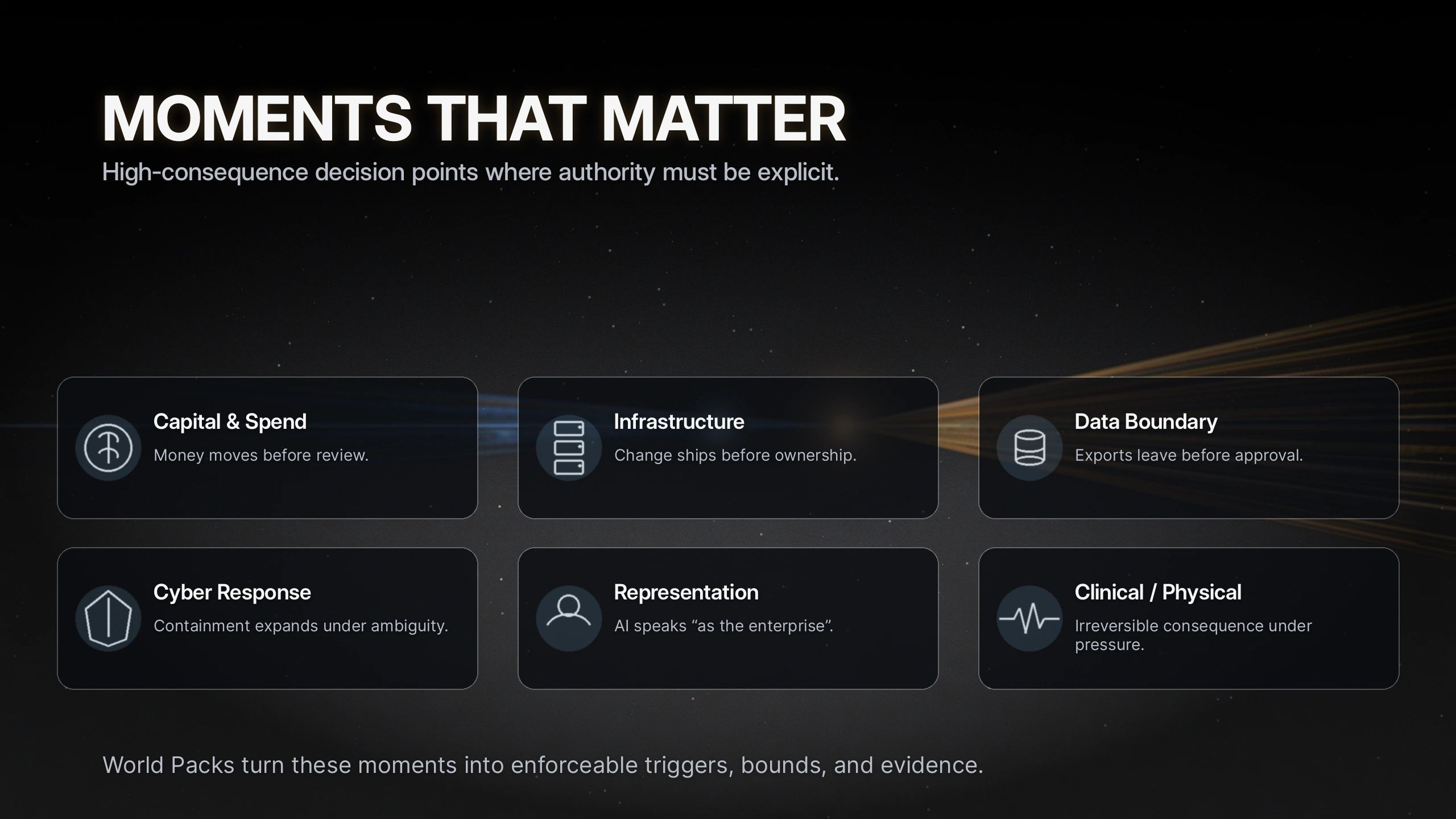
Modern systems can move capital, reconfigure infrastructure, expose data, alter representation, and chain tool actions before anyone can intervene.
When the interval between decision and consequence collapses, authority drifts into runtime behaviour.
Responsibility becomes implicit.
Accountability arrives after outcome.
This is not operator failure.
It is architectural.
Judgement Spine restores structure at the moment before consequence:
Acceleration remains. Drift does not.


Judgement Spine is one consistent runtime system: a Core Control Plane plus modular World Packs.
Judgement Engine (Decision Logic)
Evaluates intent + context + doctrine + authority + uncertainty → returns:
ALLOW / ALLOW WITH BOUNDS / ESCALATE / BLOCK / SAFE DEGRADE
Execution Control Plane (Enforcement)
Enforces the outcome at the last safe moment. Applies bounds (scope, TTL, limits, rollback conditions) and safe-degrade modes (pause, restrict, route, substitute, constrain).
Evidence Pack System (Proof Before Consequence)
Writes a runtime decision record before impact: intent, triggers, doctrine versions, authority chain, bounds, escalation path, actions taken, linked artefacts, integrity references.
Adapter / Integration Contract (Portability)
Converts tool and workflow events into standard triggers and pushes enforcement back into live systems.
Worlds stay vendor-agnostic. Tool specificity lives in adapters.
System map:
Adapters / Event Triggers → MTM Resolver → Judgement Engine → Execution Control Plane → Evidence Pack


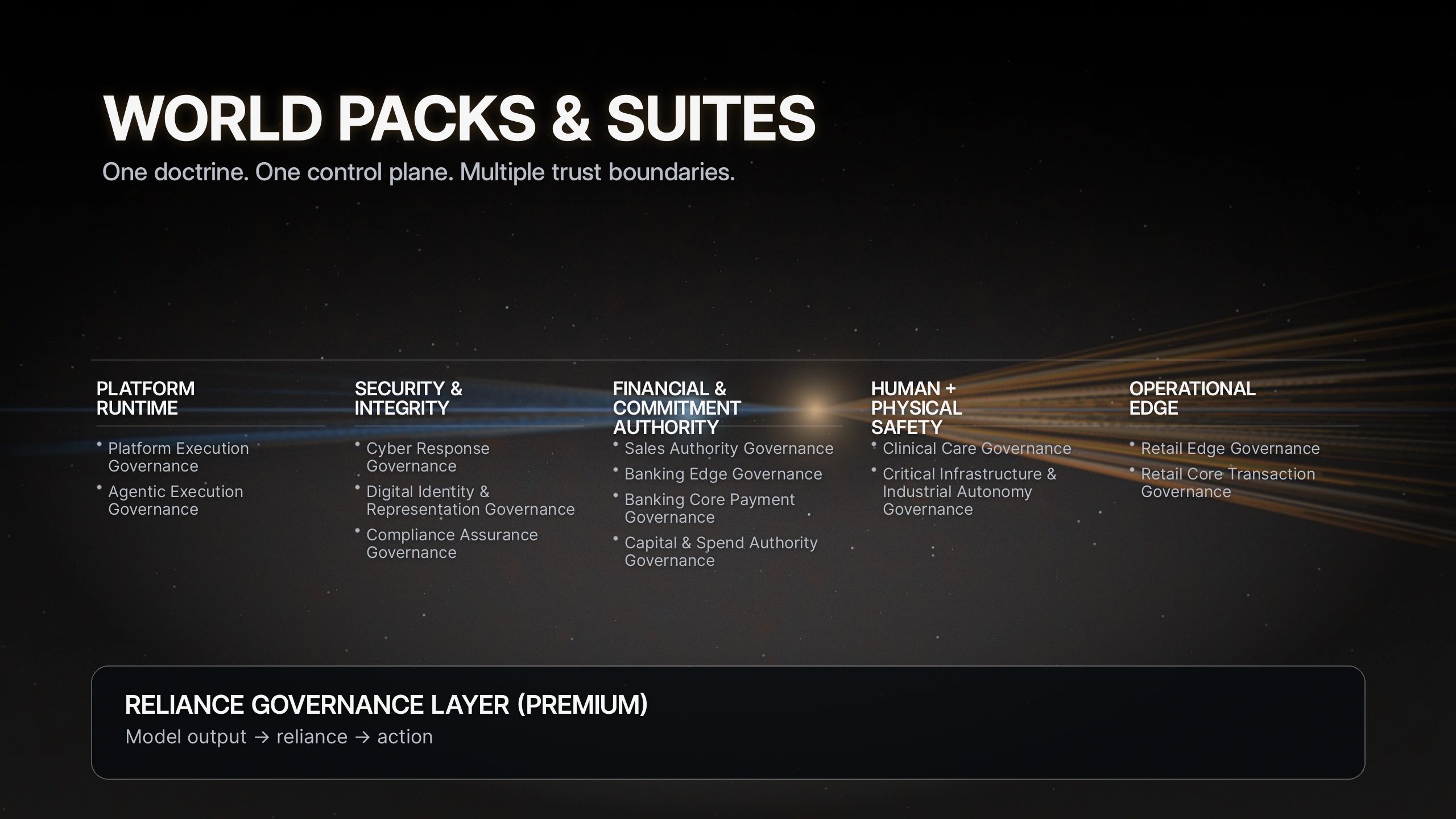
Judgement Spine ships as licensable World Packs grouped into clear product lines: one doctrine, one control plane, multiple trust boundaries.
Suites bundle related boundaries under a single line. Packs remain modular and composable across environments.
Each pack contains:
World Packs extend the platform. They do not change it
They make the doctrine operational where failure physics differ — and execution risk is structurally material.


Execution governance is not enough when AI influences judgement before action.
Judgement Spine includes a premium cross-cutting Reliance Governance Layer that governs the model-to-action boundary:
model output → reliance → action
It governs whether reliance is permitted before consequential execution begins — and records what the system relied on, what was uncertain, what conflicted, and what escalation was triggered.
Reliance evidence is linked to downstream execution evidence, closing the gap where recommendation quietly becomes action.
This is the legal and regulatory fault line for enterprise AI.
Request information


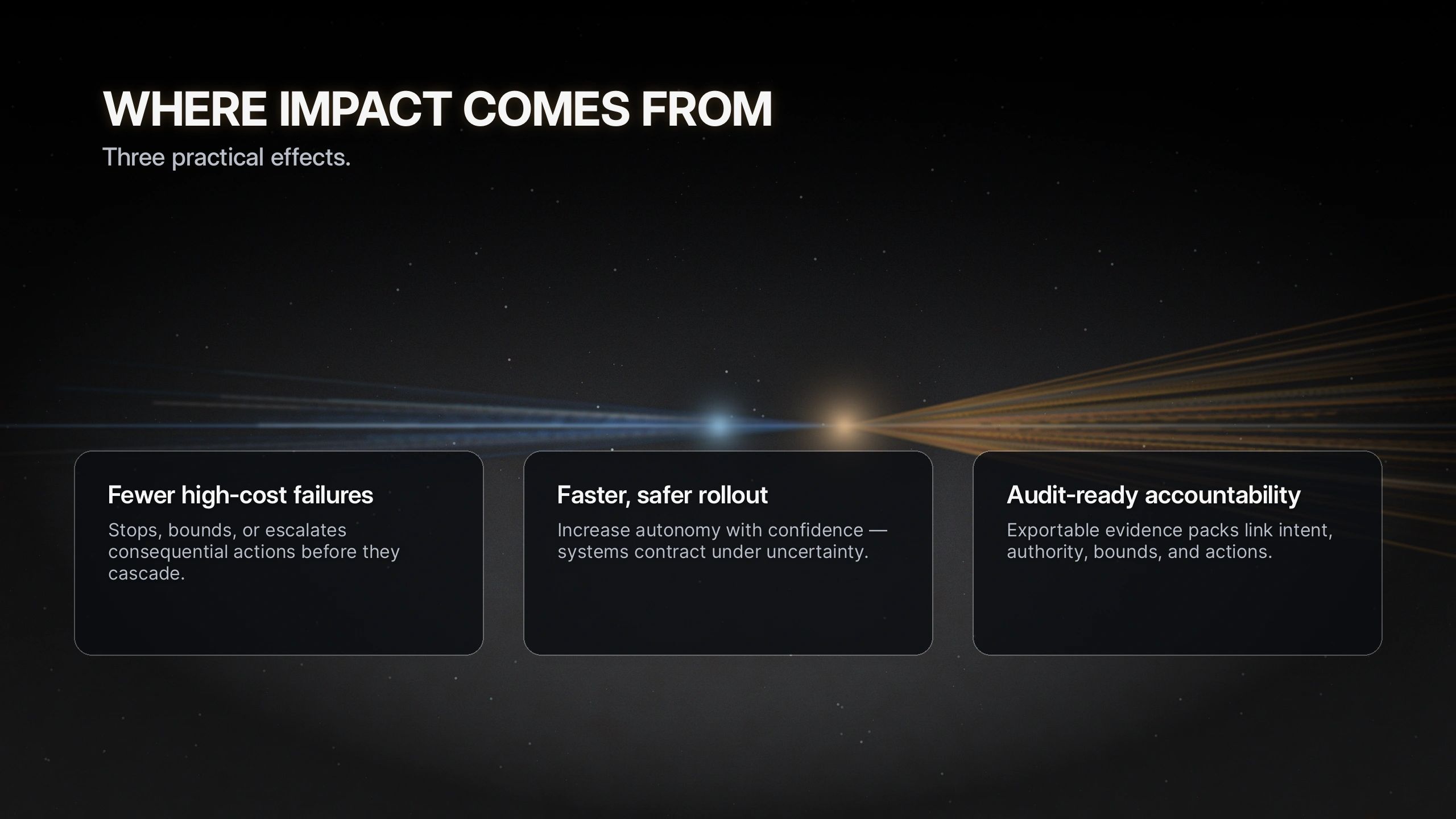
The economic and risk impact of Judgement Spine comes from three practical effects.
1) Fewer High-Cost Failures
Judgement Spine stops, bounds, or escalates consequential actions at the moment they occur — before errors cascade across systems.
Authority is checked in real time. Execution cannot proceed without explicit ownership, bounded delegation, and required escalation when uncertainty rises.
The result is a material reduction in both probability and severity of execution failures — because drift is structurally prevented, not culturally discouraged.
2) Faster, Safer Rollout of Automation and Agents
Automation and AI programmes often stall where consequence begins: exception handling, approvals, and unresolved accountability.
Judgement Spine makes authority, escalation, and safe degradation structural inside the runtime path — so deployment can move forward without losing control. Teams can increase autonomy with confidence because the system contracts under uncertainty instead of pushing ahead.
Governance stops being a blocker and becomes an enabler.
3) Audit-Ready Accountability by Default
Every consequential action can produce an exportable evidence pack with a traceable authority path:
What was proposed and what executed.
What was allowed, constrained, escalated, or blocked.
Who held authority when action began.
What escalation occurred under uncertainty — and why.
What bounds applied — and how the system degraded safely if confidence dropped.
This turns governance from policy language into proof.
Where this shows up in practice:
Security automation contains threats without triggering avoidable outages.
Customer credits, refunds, and spend approvals remain fast but controlled.
Sensitive data cannot cross boundaries without explicit authority and recorded reliance.
Infrastructure and production changes pause automatically when novelty, blast radius, or uncertainty rises.
Representation and communications cannot be generated “as the enterprise” without permission and evidence.

Where deployed in the execution path, Judgement Spine binds authority directly into live systems.
It can intercept consequential actions, validate the authority chain, enforce delegation bounds, trigger time-boxed escalation when uncertainty rises, and contract autonomy in real time.
Governance moves from policy to execution.
This is not advisory guardrailing.
It is enforceable control — with evidence generated by default.


© Judgement Spine®
Judgement Spine® is a registered trade mark.
The Judgement Spine doctrine, educational frameworks, terminology, and AI-related system architecture principles are protected by trade mark and copyright law.
Use of Judgement Spine® in educational, technical, AI, commercial, or operational contexts is subject to licence.
No rights are granted except as expressly agreed in writing.